Ahrefs Domain Rating set in type 2 Nov 2026, reset 1 Nov 2026.
An open source AI coding agent that automates GitHub Issues into merged pull requests and tagged releases through independent review and automated testing.
The story so far
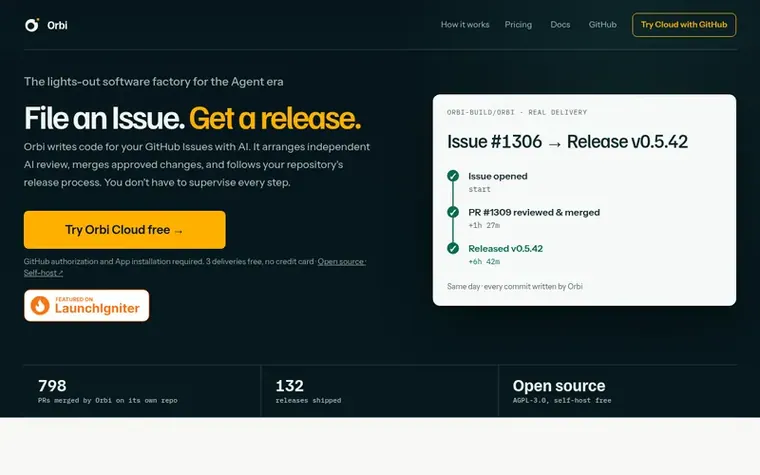
Homepage of Orbi
Orbi is a lights-out software factory that turns GitHub Issues into complete releases. An AI coding agent implements the Issue in an isolated worktree, then a second independent AI session reviews the code, reruns tests, and repairs any failures before merging the exact reviewed commit. The process is GitHub-native: everything from Issues through pull requests to releases stays in your repository. Orbi runs on your own infrastructure as self-hosted open source software under AGPL-3.0, or as a managed cloud service with a hosted runner. Self-hosting is free forever; cloud includes a trial of 3 free merged deliveries and paid plans starting at US$29/month.
Typeset features
Isolated worktree for each task
Exact-head merge and tagged release
Epic and milestone scoping with dependency ordering
Recovery from mid-run crashes without restarting
Bring your own AI model
GitHub-native workflow with branch protection
No code upload to infrastructure
Automatic Issue drafting from code changes
Pricing
Free: 3 merged deliveries (trial, no credit card). Self-hosted open source: free forever. Cloud Solo: US$29/month (monthly) or US$24/month (billed yearly at US$290, save 17%) including 400M tokens/month. Cloud Pro: US$79/month (monthly) or US$66/month (billed yearly at US$790, save 17%) including 1.
Orbi metrics
Set in type for orbi.build: Ahrefs Domain Rating and Majestic link data, with the change since the last edition.
Metric
Value
Domain Rating
23▲ +3 (up) since last check
Trust Flow
6● no change since last check
Citation Flow
29● no change since last check
Referring domains
89● no change since last check
External backlinks
645● no change since last check
Ahrefs Domain Rating set in type 2 Nov 2026, reset 1 Nov 2026. Lead topic: Recreation/Pets (6). Majestic set 31 Oct 2026, reset 31 Oct 2026. Link data typeset by Majestic. Trust Flow, Citation Flow and Topical Trust Flow are trademarks of Majestic-12 Ltd.
Orbi domain colophon
Read the colophon
From the registry's public RDAP record, checked 2 Nov 2026, 22:33 UTC.
Measured after Orbi went live on Zivaro Launch on 31 October 2026.
Domain Rating (Ahrefs)
23▲ +3 (up) since launch
20 at launch (31 Oct 2026), 23 on 2 Nov 2026
Referring domains (Majestic)
89
First measured 31 Oct 2026
Day 2 since launch. Next receipt: day 30, 30 Nov 2026. These are measurements, not proof of cause: many things move these numbers. Figures we have not measured are left out.
For self-hosted Orbi, you need Git, a POSIX shell, and API access to a model you already pay for. Orbi runs on Linux and macOS. No GPU is required. Self-hosted: your repository, keys, and test suite stay on your machine; nothing is uploaded to us. Cloud: the runner clones the repository you authorize onto machines we operate for the duration of a delivery.
Which AI models can I use with Orbi?
For self-hosted Orbi, bring your own model. Orbi works with any OpenAI-compatible API or a locally hosted model. Model spend goes to your provider at your rate; the self-hosted core has no platform fee. Cloud includes model usage.
How is Orbi different from GitHub Copilot or Cursor?
Copilot and Cursor are editors that make you faster while you type. Orbi works when nobody is typing: it takes an Issue from your backlog, works in an isolated worktree, and takes it through review and merge to a tagged release. A second independent session reviews and repairs the code.
What happens when a run crashes halfway?
The next tick returns to the same scene. Because the Issue, pull request, labels, and run ID live in GitHub, restarts reconstruct the same run, branch, worktree, and PR without needing a second story about what happened.
Who reviews the AI's code?
Another Orbi session, running independently of the one that wrote the code, and it can change the branch rather than only comment. It reruns tests against its own repairs. You stay the last gate: work lands as a normal GitHub pull request, so branch protection, required checks, and human approvals still apply.

 y
 Amotions AI
 Contextli
 VocalCode