Ahrefs Domain Rating set in type 3 Nov 2026, reset 30 Oct 2026.
Fileverity detects AI-generated and edited images, AI-written text and altered documents, with traceable timestamped reports that anyone can verify.
The story so far
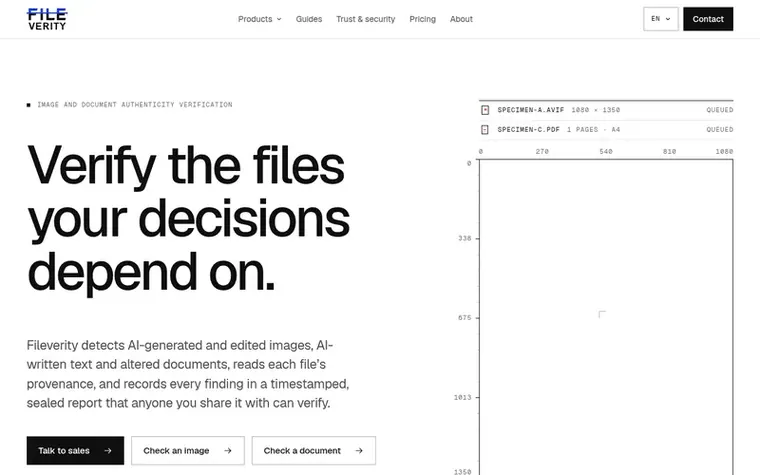
Homepage of Fileverity
Fileverity is a file authenticity verification service for businesses, developed by Entogo Inc. in Toronto, Canada. It examines images and documents, detecting AI generation, manipulation, AI-written text and alterations. The service analyzes images for provenance, metadata and editing traces, and checks documents for AI-written passages, photos inside, scanned pages and edit history. Every finding is recorded in a timestamped report sealed as a PDF and verifiable by anyone. Files are never retained after analysis. Enterprise customers can run Fileverity on-premises, fully offline, without external APIs.
Typeset features
Detects text changes after saving or digital signing
Generates traceable, timestamped reports verifiable by anyone
Supports on-premises and fully offline deployment for Enterprise
Files never retained after analysis
Pricing
Pricing model: Freemium
Free Flash check per account (one image and one document). Image Pro: US$2.99 per report, US$23.90 for 10 reports (US$2.39 each), US$159 for 100 reports (US$1.59 each). Doc Pro: US$8.99 per report, US$69.90 for 10 reports (US$6.99 each), US$489 for 100 reports (US$4.89 each). Enterprise with API, on
Fileverity metrics
Set in type for fileverity.com: Ahrefs Domain Rating and Majestic link data, with the change since the last edition.
Metric
Value
Domain Rating
0● no change since last check
Trust Flow
0● no change since last check
Citation Flow
0● no change since last check
Referring domains
0● no change since last check
External backlinks
0● no change since last check
Ahrefs Domain Rating set in type 3 Nov 2026, reset 30 Oct 2026. Majestic set 30 Oct 2026, reset 30 Oct 2026. Link data typeset by Majestic. Trust Flow, Citation Flow and Topical Trust Flow are trademarks of Majestic-12 Ltd.
Fileverity domain colophon
Read the colophon
From the registry's public RDAP record, checked 1 Nov 2026, 10:40 UTC.
Measured after Fileverity went live on Zivaro Launch on 30 October 2026.
Domain Rating (Ahrefs)
0● no change since launch
0 at launch (30 Oct 2026), 0 on 2 Nov 2026
Referring domains (Majestic)
0
First measured 30 Oct 2026
Day 4 since launch. Next receipt: day 30, 29 Nov 2026. These are measurements, not proof of cause: many things move these numbers. Figures we have not measured are left out.
Fileverity verifies images for AI generation, local edits, provenance including Content Credentials and metadata, and AI labels. For documents, it examines AI-written text, file history, and with Doc Pro also analyzes photos inside, scanned pages and edit history. Documents supported include PDF, DOCX, DOC, RTF, ODT, PPTX and TXT up to 100 pages and 50 MB; images supported are JPEG, PNG and WebP up to 10 MB.
How is Fileverity different from other AI detectors?
Fileverity differs in four ways: files are never retained or used for training; detection uses proprietary continuously updated models covering major generator families in one analysis rather than single-vendor watermarks; Enterprise customers can run it on-premises and fully offline; and every report is traceable, bound to the file by its fingerprint, timestamped under RFC 3161 and verifiable by anyone.
How does Fileverity detect AI-written text in documents?
Fileverity's model FVDOC V3 evaluates each paragraph with enough running text in English, French, German, Spanish or Chinese and flags passages that read as AI-written with page or paragraph references. A document needs at least about 150 words of text; Doc Pro also reads scanned pages.
Can Fileverity detect altered or fraudulent documents?
Yes, with Doc Pro. In one analysis it checks whether a document's text is AI-written, whether photos inside are AI-generated or edited, and whether a PDF's text was changed after first saving or digital signing. Each finding states its basis and strength, and the report gives one verdict from L0 to L5 with a recommended action.
How does Fileverity tell whether a photo was generated or edited?
Fileverity answers the two questions separately. An image generated as a whole is reported as AI-generated, and a Pro analysis names the likely model family when the evidence allows. A real photo with altered areas is reported as a photo with local alterations, and a Pro analysis marks each region, including areas regenerated with generative fill. Content Credentials, metadata and AI labels are read alongside.
Leave a review for Fileverity
No review of Fileverity set in type yet. Set the first.

 Accessia
 Tawa Guard
 orbench
 Libretto