Ahrefs Domain Rating set in type 2 Nov 2026, reset 2 Nov 2026.
Stop risky agent actions before they run and approve them from your phone, with every decision recorded in a signed ledger.
The story so far
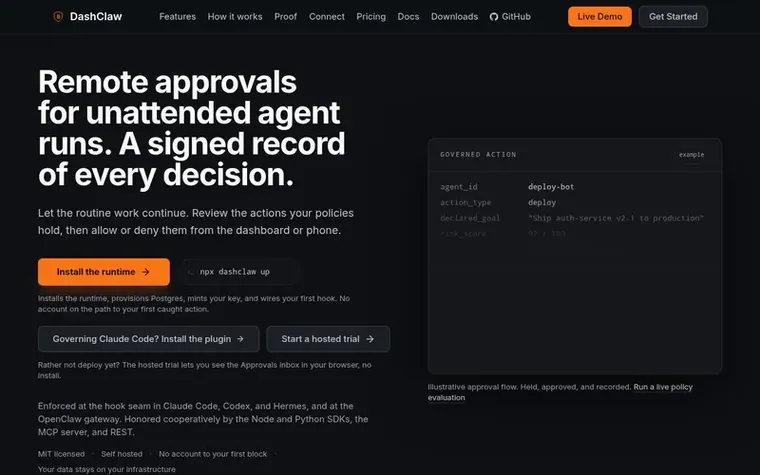
Homepage of DashClaw
DashClaw is an approval layer that sits between unattended AI agents and their actions. It intercepts tool calls from supported runtimes like Claude Code, Codex, Hermes, and OpenClaw, evaluates them against your policies, and pauses high-risk actions for human approval before they execute. Every decision is recorded in a replayable audit trail with explicit identity and signature verification.
Unlike native permission prompts that require you to be present, DashClaw protects the runs you walk away from. You can approve or deny actions from your phone minutes or hours later. The product includes an approvals inbox, a signed decisions ledger, customizable policies, and enforcement liveness checks. It works with OpenClaw, Hermes, Claude Code, Codex, Meta Muse, and MCP, as well as Node and Python SDKs.
DashClaw is self-hosted under the MIT license at no cost, or available as a hosted service for teams. The self-hosted version is free and gives you full control over your data and infrastructure. Hosted plans include managed infrastructure, real-time support, and data retention.
Typeset features
Intercepts risky agent actions before execution
Works with Claude Code, Codex, Hermes, OpenClaw, and MCP
Policy-based risk scoring and decision making
Remote approvals from phone or browser
Signed audit ledger with replayable records
Calibrated interruptions that reduce false positives
Enforcement liveness monitoring via synthetic probes
Self-hosted (MIT licensed) or managed hosting options
Approvals inbox with decision ledger and policies
Agent defense documentation with assumptions and shields
Set in type for dashclaw.io: Ahrefs Domain Rating and Majestic link data, with the change since the last edition.
Metric
Value
Domain Rating
8▲ +1 (up) since last check
Trust Flow
3● no change since last check
Citation Flow
30● no change since last check
Referring domains
88● no change since last check
External backlinks
439● no change since last check
Ahrefs Domain Rating set in type 2 Nov 2026, reset 2 Nov 2026. Lead topic: Computers/Systems (3). Majestic set 1 Nov 2026, reset 1 Nov 2026. Link data typeset by Majestic. Trust Flow, Citation Flow and Topical Trust Flow are trademarks of Majestic-12 Ltd.
DashClaw domain colophon
Read the colophon
From the registry's public RDAP record, checked 3 Nov 2026, 04:44 UTC.
Measured after DashClaw went live on Zivaro Launch on 1 November 2026.
Domain Rating (Ahrefs)
8▲ +1 (up) since launch
7 at launch (1 Nov 2026), 8 on 2 Nov 2026
Referring domains (Majestic)
88
First measured 1 Nov 2026
Day 1 since launch. Next receipt: day 30, 1 Dec 2026. These are measurements, not proof of cause: many things move these numbers. Figures we have not measured are left out.
What is the difference between DashClaw and native permission prompts in Claude Code?
Native permission prompts require you to be present for each prompt in real time. DashClaw protects runs you walk away from by freezing dangerous calls and letting you approve them minutes or hours later from anywhere, with shared policies across runtimes and a replayable audit trail.
How does DashClaw record actions and decisions?
Every governed action is recorded in a signed decision ledger with explicit identity and payload-signature status, creating a replayable audit trail that can be exported, verified, and audited without a separate pipeline.
Can I use DashClaw without paying?
Yes. DashClaw is MIT licensed and free to self-host on your own infrastructure with no account required. You only pay if you want hosted infrastructure, managed support, and data retention handled by the DashClaw team.
What happens if I leave the hosted plan?
Leaving is easy. Any hosted workspace can export its full decision history and configuration as one file and re-import it into a self-hosted instance you control at any time. Nothing about hosted is a one-way door.
Does DashClaw enforce actions across all integrations equally?
No. DashClaw publishes an honest enforcement boundary table. Claude Code, Codex, Hermes, and OpenClaw provide mechanical halt. SDKs, MCP, and REST integrations honor decisions cooperatively. DashClaw is a seatbelt against accidents, not a cage against intent.
Leave a review for DashClaw
No review of DashClaw set in type yet. Set the first.

 Kimchi Coding
 Rigorix
 Verdict
 rightcommit