Majestic link data for heal.dev. Arrows show the change since the previous check.
Metric
Value
Trust Flow
9● no change since last check
Citation Flow
27● no change since last check
Referring domains
63● no change since last check
External backlinks
348● no change since last check
Lead topic: Computers/Internet/On the Web (8). Majestic set 25 Oct 2026, reset 25 Oct 2026. Link data typeset by Majestic. Trust Flow, Citation Flow and Topical Trust Flow are trademarks of Majestic-12 Ltd.
heal domain colophon
From the registry's public RDAP record, checked 25 Oct 2026, 21:50 UTC.
A tool that builds a sandbox replicating production to find reproducible bugs and runtime vulnerabilities with failing tests that prove them, running locally or
The story so far
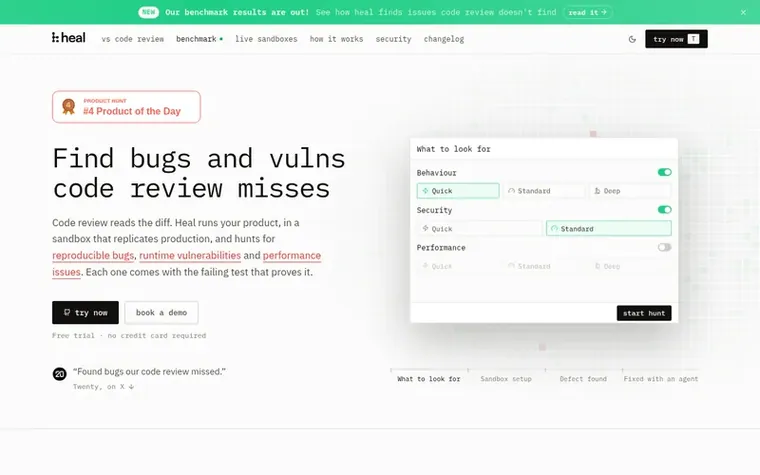
Homepage of heal
Heal complements code review by running your entire product in a sandbox that replicates production. While code review reads diffs, Heal executes your application and hunts for reproducible bugs, runtime vulnerabilities, and performance issues. It learns how to run your environment, mocks what cannot run, reads your code for suspicions, and validates findings against the sandbox. Every defect comes with a failing test that reproduces it. Heal goes beyond E2E tests and security scanners by testing untested integrations, edge cases, services disabled in staging, and catching issues that require runtime visibility. Each finding includes steps, captures, and the failing test that turns green once fixed. You can run it locally or in the cloud, and it's free for open source projects.
Typeset features
Builds a sandbox that replicates production environment
Mocks or emulates third-party services like payments, mail and APIs
Provides failing test for every defect found
Maps product architecture and reads code for suspicions
Validates security issues with real exploits against sandbox
Crawls every link and finds missing routes
Runs locally or in the cloud
Pricing
Pricing model: Free trial
Free for open source projects. Paid plans available for commercial use; specific pricing not listed.
Code review reads the diff of one pull request, while Heal runs your entire product in a production-like sandbox. This allows Heal to find bugs that exist between untouched code, config, data and third-party services—things that a diff cannot show. Code review can only comment on lines of code, but Heal provides a defect with steps, captures, and a failing test that proves the issue.
How does Heal validate that bugs are real?
Heal proves findings by having a test fail twice, then fail again when Heal re-runs it itself. What it cannot reproduce, it does not file as a defect.
What does Heal catch that E2E tests and security scanners miss?
Heal catches edge cases, untested integrations, services turned off in staging, hard-to-mock async services, missing routes, and validated runtime security issues. E2E tests only run the happy path against staging where services are switched off, while security scanners report patterns that may never be reachable. Heal runs everything in a production-like sandbox and validates what can actually be exploited.
Does Heal require changes to how we use code review?
No. Code review is kept in place and continues to read every pull request. Heal runs on the whole product weekly or before a release, providing what a diff cannot show.
How does Heal handle third-party services like payments and email?
Heal mocks or emulates third-party services in the sandbox, then replays them failing, slow, or answering twice to test edge cases. This allows full testing of payment flows, mail sending, and API integrations without calling the actual services.

 GPTZero
 Originality.ai™
 Papercuts