Ahrefs Domain Rating set in type 12 Nov 2026, reset 10 Nov 2026.
A free web application that calculates the number of agents needed to meet service level targets using Erlang C formulas.
The story so far
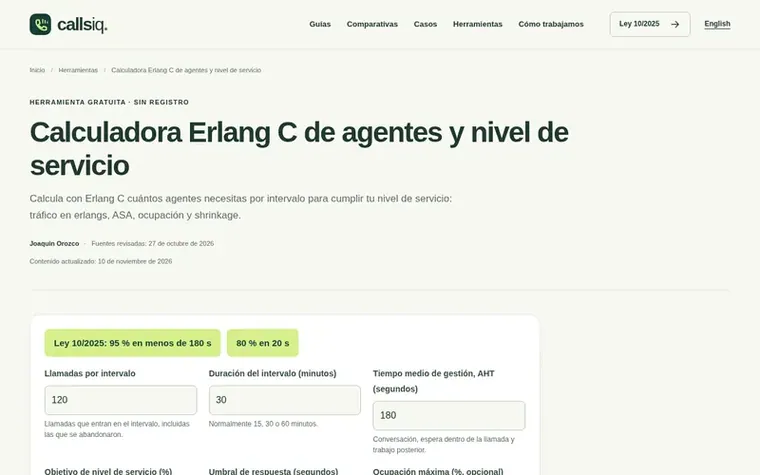
Homepage of CallsIQ
CallsIQ's Erlang C calculator is a free web application for contact centers to compute staffing requirements. Users enter call volume, call duration (AHT), service level targets, and optional occupancy limits to determine the minimum number of connected agents needed per time interval. The tool displays results in a table showing service levels, average speed to answer (ASA), and occupancy rates, helping planners meet objectives like Spain's Law 10/2025 requirement of 95% of calls answered within 180 seconds. The calculator operates in the user's browser without requiring registration or data transmission to CallsIQ servers.
Typeset features
Calculates minimum agents needed for service level targets
Want to see what CallsIQ does next? Follow them for milestones, new products and stories by email.
CallsIQ metrics
Set in type for callsiq.com: Ahrefs Domain Rating and Majestic link data, with the change since the last edition.
Metric
Value
Domain Rating
0● no change since last check
Trust Flow
0● no change since last check
Citation Flow
4● no change since last check
Referring domains
3● no change since last check
External backlinks
3● no change since last check
Ahrefs Domain Rating set in type 12 Nov 2026, reset 10 Nov 2026. Majestic set 10 Nov 2026, reset 10 Nov 2026. Link data typeset by Majestic. Trust Flow, Citation Flow and Topical Trust Flow are trademarks of Majestic-12 Ltd.
CallsIQ domain colophon
Read the colophon
From the registry's public RDAP record, checked 12 Nov 2026, 16:41 UTC.
Measured after CallsIQ went live on Zivaro Launch on 10 November 2026.
Domain Rating (Ahrefs)
0● no change since launch
0 at launch (10 Nov 2026), 0 on 11 Nov 2026
Trust Flow (Majestic)
0
First measured 10 Nov 2026
Referring domains (Majestic)
3
First measured 10 Nov 2026
Day 1 since launch. Next receipt: day 30, 10 Dec 2026. These are measurements, not proof of cause: many things move these numbers. Figures we have not measured are left out.
Erlang C calculates the probability that a call will need to wait in queue with N agents serving A traffic intensity. From this probability, the tool derives service level (percentage of calls answered within a threshold), average speed to answer (ASA), occupancy, and staffing needs including shrinkage.
What data does the calculator collect?
The calculator does not send user data to CallsIQ. All calculations run in the user's browser. Google Analytics records only that the tool was visited and used, never the values entered.
What are the main assumptions and limits of the model?
The model assumes Poisson arrivals, exponential call durations, FIFO queue discipline, and that no one abandons while waiting. It does not model abandonment, intra-interval peaks, transfers between queues, or agents handling multiple queues simultaneously. With very few calls, the model is sensitive to AHT variations.
How is traffic intensity (erlangs) calculated?
Traffic intensity in erlangs is calculated as the number of calls multiplied by the average handle time (AHT) divided by the interval duration in seconds: A = calls × AHT ÷ interval seconds. One erlang equals one resource continuously occupied.
Leave a review for CallsIQ
No review of CallsIQ set in type yet. Set the first.

 Calconic
 Disk Prices
 How Much Is It Worth
 TrustTheCalcs